
The Bench: A whopping 357,000 comments received on the changes to the Endangered Species Act. What happens next?
by Christin Bratton

Christin Bratton
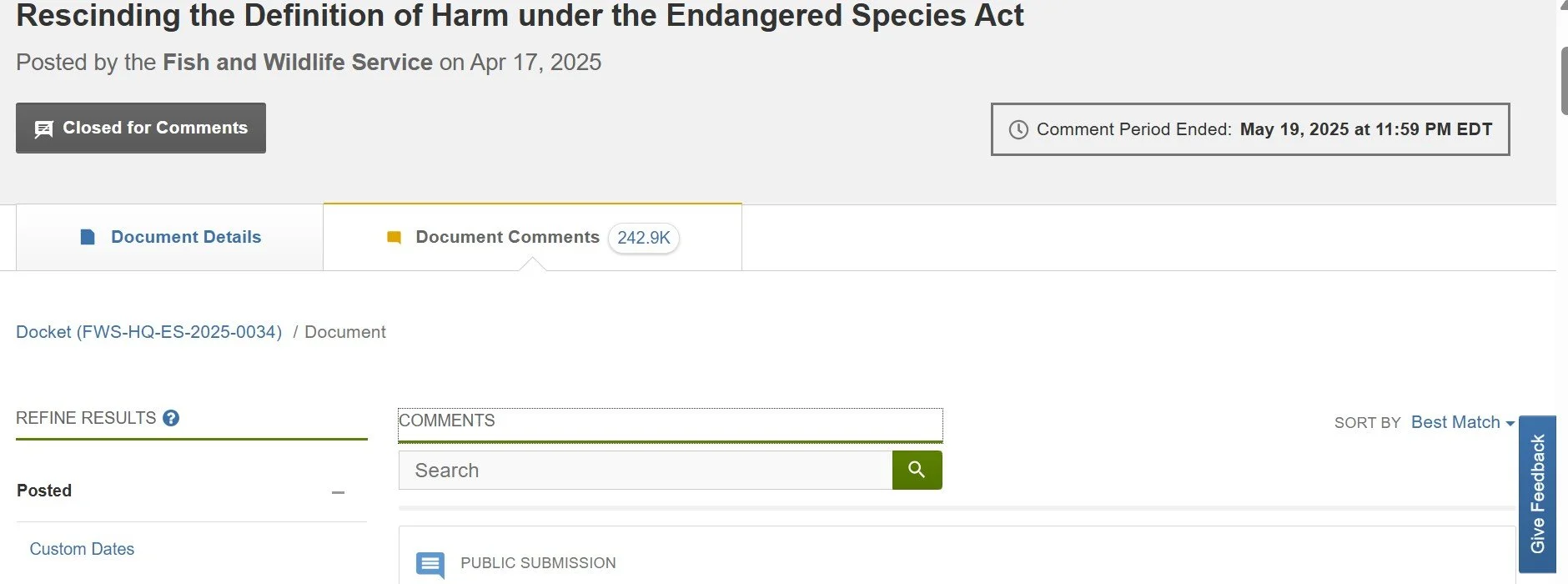
The public comment period to rescind the regulatory definition of “harm” under the Endangered Species Act closed last May. More than a whopping 357,000 comments were submitted nationwide. As of today, the rule is still under review.
You can find the full record by visiting Regulations.gov and searching the docket number FWS-HQ-ES-2025-0034-0001.
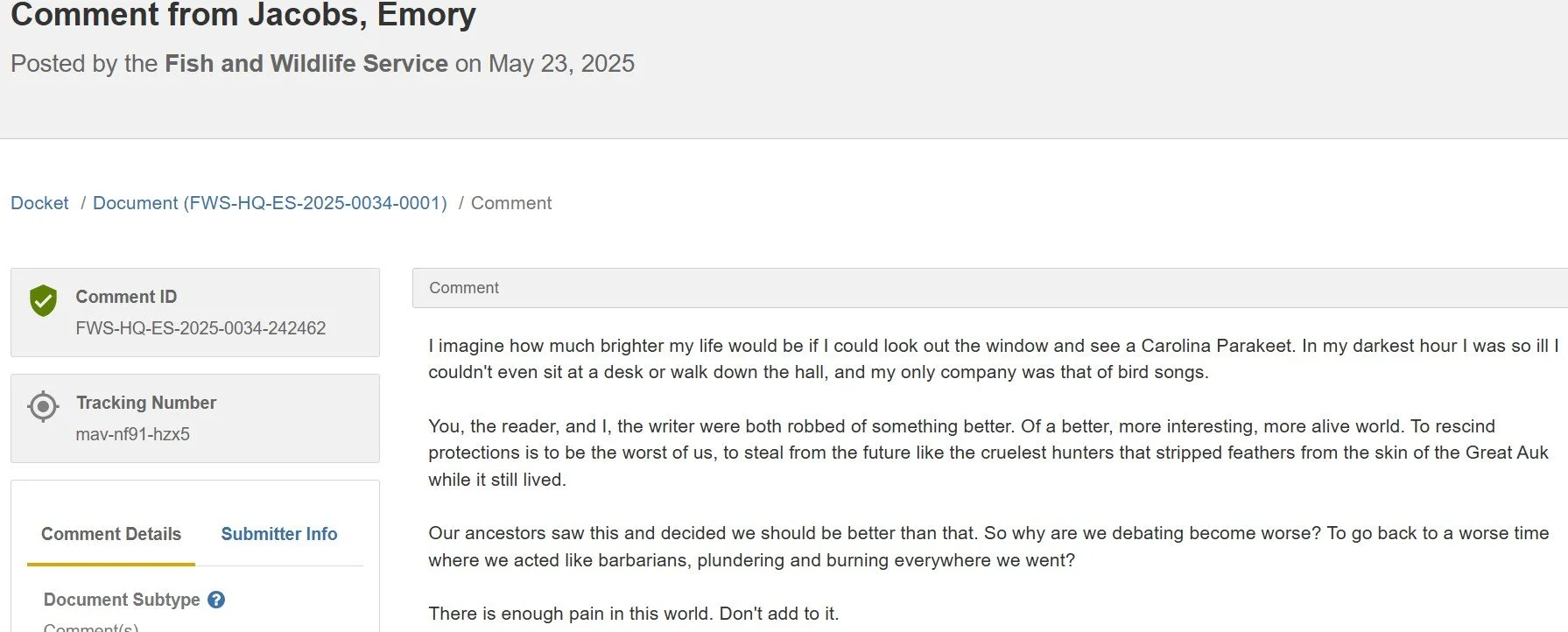
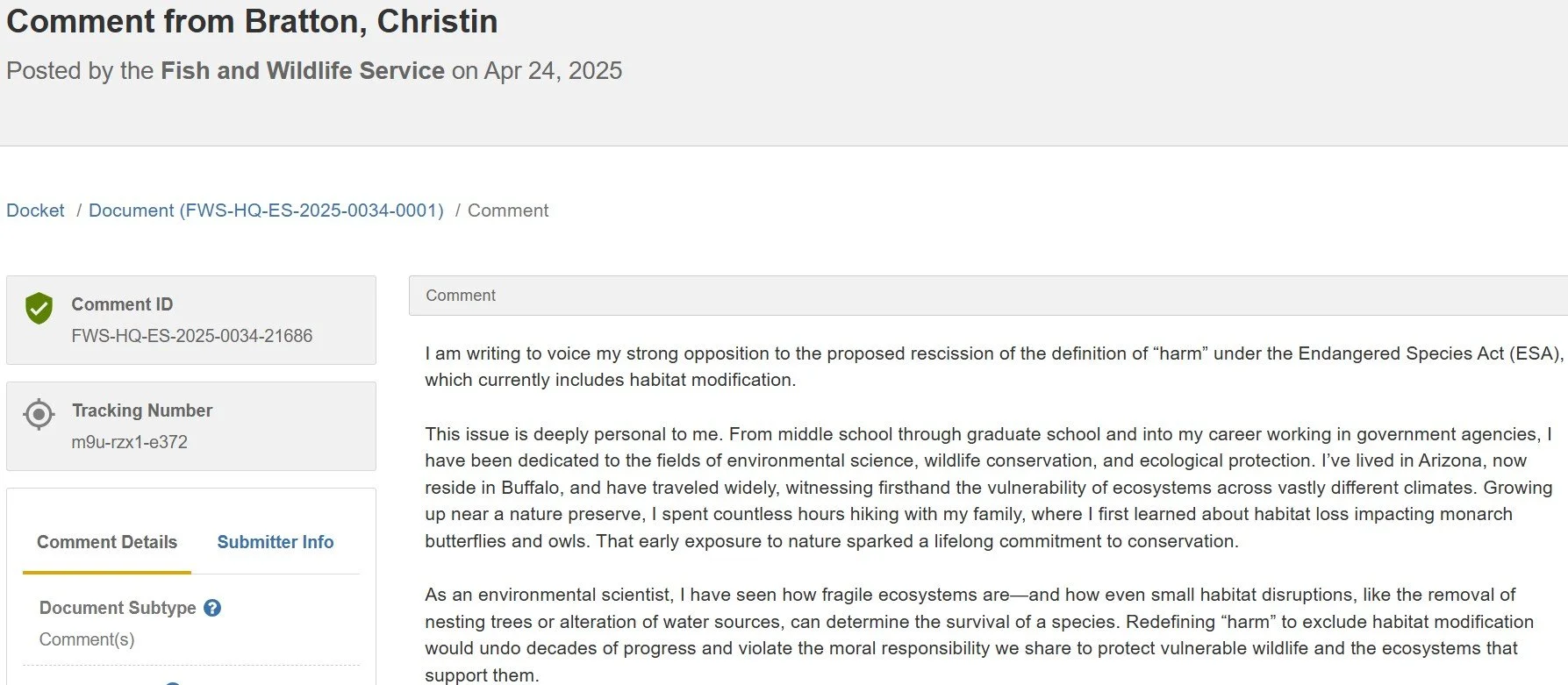
Across the public docket, which you can view by visiting Regulations.gov and searching FWS-HQ-ES-2025-0034-0001, several consistent themes emerge. Commenters questioned whether removing the regulatory definition of “harm” creates internal inconsistency within the statute, particularly when terms like “harass” and “pursue” remain. Others emphasized that habitat destruction produces measurable biological injury, even when no animal is directly struck or killed. Many argued that excluding habitat modification from “harm” narrows enforcement in a way that weakens practical protections. The volume, more than 357,000 submissions, reflects not only disagreement, but a widespread concern over how definitional changes shape real world outcomes for species and the professionals tasked with reviewing their protection.
You could imagine any legal document that receives this much public engagement signals concern. There is opposition here.
For me, this is painful to watch unfold. On a regular basis, I conduct environmental reviews that include Endangered Species Act compliance. When I evaluate a project, I am not only asking whether an animal will be directly injured. I am reviewing habitat and potential disturbance. I am reviewing whether indirect effects accumulate into measurable biological harm.
The word “harm” has operational meaning in my daily work.
Historically, “harm” has included significant habitat modification that results in injury to listed species. That interpretation shaped how projects were redesigned, how mitigation was structured, and how risk was assessed.
If the regulatory definition changes, the review process changes. And let me say, the changes are in effect now. Not from this pending action. But from administration actions that have already taken into effect. Namely, when Lee Zeldin announced the largest deregulatory action in U.S. history, aiming to eliminate over "$1.3 trillion in regulatory costs."
It changes how effects are framed, what triggers consultation, how far analysis extends, and how lenient and unaccountable companies can be.
Recently, we have seen several species delisted. That is good news when recovery is real and measurable. Delisting should represent biological success.
But in the current regulatory climate, I find myself asking a harder question.
Is a species being delisted because recovery goals were met? Or are the standards for protection shifting?
Delisting decisions must be based on data, population trends, habitat stability, reproductive success, and long-term resilience. Not to mention transparency of data.
If protections narrow while habitat pressures increase, then delisting becomes harder to interpret.
In practice, ESA review is a balance between development and protection. It always has been. But definitions written on legal documents are what holds in court. When leaders are keeping things within their personal circles, they have leverage that leaves the rest of us and wildlife behind with no way to provide input unless it is through their terms. When definitions shift, the regulatory center of gravity shifts with them.
Nearly 358,000 people weighed in on this proposal. That does not predetermine the outcome. Agencies still decide.
But those comments now sit in the administrative record. Courts review those records and future policy builds on records. I am happy to be able to share my comments to aid in the decision-making process.
From where I sit, I need clear standards to apply consistently. Species need stable frameworks that do not oscillate with political cycles.
Recovery is something to celebrate, yes! Until the rule is finalized, the existing definition stands. For now, habitat still counts.
To read more specific details about my public comment submission, view visuals, and view the links and sites referenced, please visit https://www.terraonthebench.com/blog/12
About the Author
Christin Bratton is an Environmental Scientist and the founder of Terra on the Bench™ Studios, a creative collective dedicated to environmental storytelling and advocacy. Through her media project E3O Files, she explores environmental justice, sustainability, and the everyday connections between people and the planet. I’ve called Buffalo home since I was seven. I came up through the city’s public schools, took part in every program and opportunity this community offered, and those roots shaped who I am. Now, at 26, I work in environmental policy across the country—but I always return to Buffalo to invest what I’ve learned back into it.
About Terra on the Bench™
Terra on the Bench™ Studios is a creative collective and media studio founded by environmental scientist Christin Bratton. We expose truths, educate communities, explore nature, and oppose environmental injustice through storytelling that bridges science and culture.
Our work sits at the intersection of environmental policy, creative media, and social awareness. Through articles, coloring books, digital art, and documentary-style features, Terra on the Bench transforms complex sustainability issues into conversations people actually want to have.
At its core, Terra on the Bench is a seat of observation—a place to pause, reflect, and rethink how humans live with the planet. From disaster zones to city parks, and from Buffalo’s East Side to coastlines across the country, we bring environmental science to life through curiosity, creativity, and insight for the conservation and professional sectors, and the public.