
Across That Bridge: A Book by The Honorable John Lewis
Several years ago, I was invited to give a presentation on the book entitled: Across That Bridge: A Vision for Change and the Future of America, which was written by the Late Congressman John Lewis and published in 2012. I really appreciated the opportunity to read this book because I learned a great deal. Although I have been recording African American History for almost 50 years, I always emphasize that no matter how old you are, “you never stop learning.”
I began my presentation with a short biography of John Robert Lewis, who was a civil rights leader who served in the United States House of Representatives. He was born on February 21, 1940, in Troy, Alabama and was the third of ten children. His parents were sharecroppers and very poor. As a boy he wanted to be a preacher and at the age of 5 he began to preach to his family’s chickens on the farm. At the age of 15, he preached his first public sermon. He met two famous people before the age of 18— Rosa Parks and Rev. Dr. Martin Luther King, Jr. He also met the Rev. Billy Graham who he greatly admired. Rev. Graham encouraged John Lewis to continue his goal to be a preacher.
As I recalled the story about John Lewis preaching to the chickens, it reminded me of my grandfather’s farm. My mother always took us south to Alabama when school was over in June. We would spend the entire summer on the farm where she grew up as a child. I remember feeding the chickens that my grandfather raised. We would carry a pail of shelled corn out into the yard and spread it around the yard. The chickens would come running to eat the corn. As I reflected on John Lewis and the story of him preaching to the chickens, I could not help but imagine that he had a container of corn and while the chickens were eating, he was preaching. It must have been quite a sight!
However, as he got older his dreams turned into another passion. He became a writer. He wrote a novel and created a comic book on civil rights for children. He won the Coretta Scott King book award and the Robert F. Kennedy book award in 2014. In 2016, he won the national book award in young people’s literature. He received hundreds of awards during his lifetime including the Profile in Courage Award. President Barack Obama honored him with the Presidential Medal of Freedom. He also received over 30 Honorary Doctorate degrees from various universities and colleges.
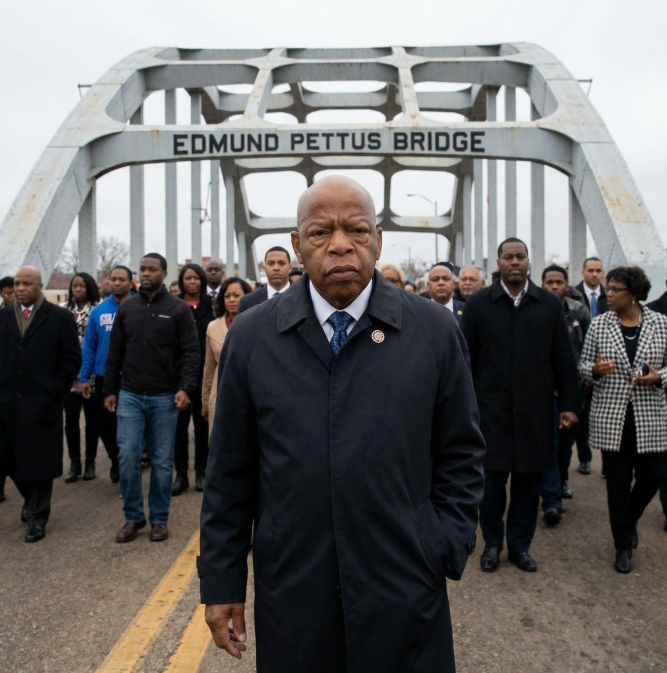
Most Americans know John Lewis as a major civil rights leader. The picture of him being beaten bloody on the bridge to Selma, Alabama has been seen many times. Lewis was only 25 years old at the time he crossed the Edmund Pettus Bridge on March 7, 1965. It began as a peaceful march for voting rights, but it is remembered as “Bloody Sunday.” Alabama state troopers attacked the marchers with night sticks and surrounded them with tear gas. John Lewis suffered from a fractured skull and was one of dozens of marchers who were hospitalized. News coverage of the brutal beatings by state troopers put pressure on Congress to pass the 1965 Voting Rights Act, barring states from enforcing discriminatory laws that prevented Blacks from voting. John Lewis emerged as a leader in the fight for equal rights. He was arrested dozens of times. Later in life he would refer to this as “Getting into Good Trouble.”
Congressman John Lewis died on July 17, 2020, from pancreatic cancer at the age of 80. He crossed the Edmund Pettus Bridge for the last time in a horse- drawn carriage, 55 years after that horrible day. There is a movement to rename the bridge in his honor. The work of Congressman John Lewis is seen in many ways in the book “Across the Bridge.” The pictures in the center of the book really tell the story of his commitment to civil rights, and this book should be required reading for students in middle and high school. John Lewis stated the following words at the end of the book: “You are a light. You are the light. Never let anyone – any person or any force, dampen, dim, or diminish your light. Study the path of others to make your way easier. Lean toward the whispers of your own heart, discover the universal truth, and follow its dictates. Know that truth always leads to love and the perpetuation of peace. Clothe yourself in the work of love, in the revolutionary work of nonviolent resistance against evil. Choose confrontation wisely, but when it is your time don’t be afraid to stand up, speak up, and speak out against injustice.”
As African Americans prepare to observe the 250 years of the United States of America. It is important that we remember this History before it is erased from our memory. This column will be dedicated to remembering the history of America, both good and bad. I invite my readers to pass it on to your family, our youth, and community members in general!!