
The Berlin Conference and How Africa was Carved Up - Part 2
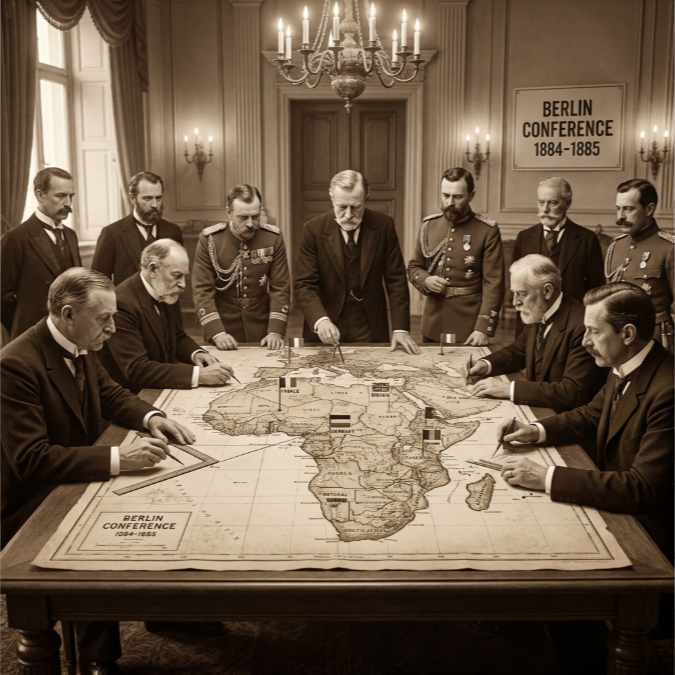
In part 1 of The Berlin Conference, I explained it was a meeting of European Nations to discuss how they would divide the continent of Africa for its resources. It included representatives from the United States, Britain, Germany, Portugal, and Belgium. The meeting was called to establish rules to prevent war over claims of land in Africa. By the end of the meeting, Europeans owned most of Africa and drew boundary lines that lasted until 1914. The Africans were not invited to the meeting. Great Britain wanted most of the land and was given Nigeria, Egypt, the Sudan, Kenya, and South Africa after defeating the Dutch settlers and the Zulu Nation. The British controlled the gold and ivory trade in West Africa.
They came in search of diamonds. It was one of the greatest stampedes in history, as Europeans made their way to the diamond mines of South Africa. One of those men who sought the riches of South Africa was an Englishman named Cecil John Rhodes. In 1870, he left his home to travel to Africa. South Africa was a land of great wealth— rich in soil, rich in minerals and diamonds. When Cecil Rhodes heard of the diamond mines, he immediately sought to make himself a wealthy man. He took the land and the diamond mines. The chief goal of Cecil Rhodes was to see England as the controlling force in Africa.
The natural resources of South Africa were controlled by Europeans, who used the labor of African people to work the mines. During the colonial era, the land was divided so that by 1951, the Africans who were 80 percent of the population owned less than 10 percent of the land. Blacks were not allowed to settle or to farm in two-thirds of the country, although they outnumbered the English. The English used the law, force, and taxation to force the Africans to work for them. In Southern Rhodesia, the Africans were restricted to what was called “Native Reserves.” The best of the land was saved for the rich.