
Mary Church Terrell, Daughter of Slaves, Civil Rights Leader
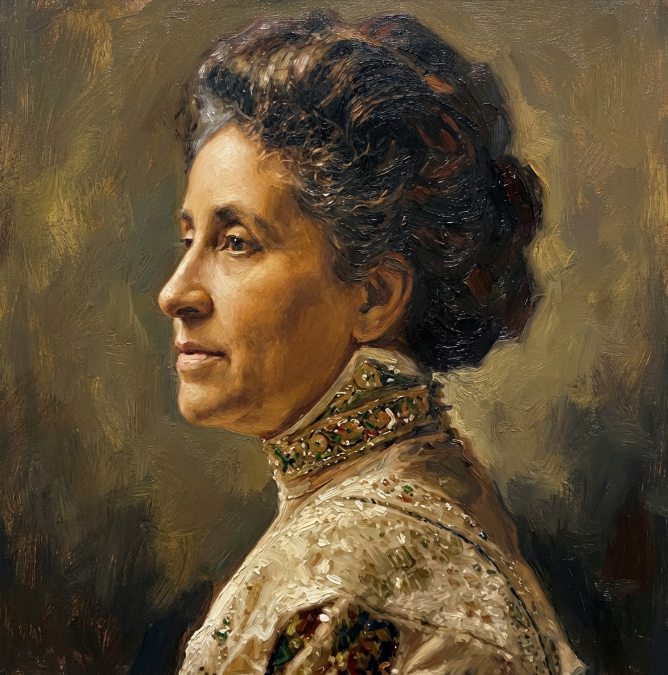
Mary Eliza Church Terrell
Mary Eliza Church Terrell was born on September 13, 1863, in Memphis, Tennessee to Robert and Louisa Church, both former slaves. Her parents were not freed until the end of the Civil War. The reconstruction era gave them an opportunity to start a business. They became successful and leaders in the struggling black middle class in Memphis. Her father bought and sold land and became one of the wealthiest men in the city. Robert Church wanted the best for his daughter, so he sent her to Oberlin College in Ohio, where she earned a bachelor’s degree in 1884. When she left Oberlin, she went to work as a teacher at Wilberforce. This school was established to help train young black students.
Mary was not satisfied with her position. She wanted to achieve more in life, so she returned to Oberlin to complete a master’s degree. Her life took a new turn when she traveled to Europe in 1888 to learn about cultures. She found more liberal views about race during her travels. When she returned to the United States in 1890, she married Robert Terrell, whom she had met in Washington. However, there was one event that changed her direction in life for the next 60 years. It was the lynching of a black man named Tom Moss on March 9, 1892.
Tom Moss was one of Mary’s best friends. They grew up as children together, attending parties and having fun. She recalled that Tom was a letter carrier and always saving his money. He continued to save money as an adult. Tom Moss, Calvin McDowell, and William Henry put their money together and went into business. They called their store the “People’s Grocery.” Blacks stopped shopping with the white owned store across the street. They began to patronize the black business. The white store owner became angry and organized a group of men to break up the black store, and a fight followed. The police were called, and the black men were arrested. The next night a mob stormed the jail. The men were taken from the jail and lynched. The scene after the lynching was horrific. Tom was shot in the neck, and McDowell was butchered and dismembered. When news of this lynching reached Mary, she was shaken to the core. Tom Moss had been a lifelong friend. She could not stand by quietly after such a brutal murder.
Mary Terrell contacted the one person that she knew would stand with her. She reached out to Frederick Douglass. At the time, Frederick Douglass was the most important African American living. He was known for his fight for the freedom of African Americans. Together they demanded a meeting with President Benjamin Harrison, which he agreed to the meeting. He listened to as they argued for a law in the United States against lynching. However, President Harrison did not make any public statement against lynching. Mary made the decision after this meeting to take another course in her life. She was determined to organize Black women across the country and to fight racism. For the next sixty years, she carried out her plan to reach every segment of American society in her fight for equality and justice for blacks.
The book entitled “Unceasing Militant,” written by Alison M. Parker, describes Mary Church Terrell’s life of activism. She became the first president of the National Association of Colored Women and a founding member of the NAACP, and she continued to work with Frederick Douglass. She also worked with the great anti-lynching crusader, Ida B. Wells. Her friends included Dr. W.E.B. Dubois, the great scholar and civil rights advocate. She became one of the most prominent activists of her time. When three companies of African American soldiers were dismissed in 1906 from the U.S. army after a racial incident in Brownsville, Texas without due process, Terrell spoke out publicly against their unfair treatment. She even demanded a meeting with the secretary of war, William Howard Taft. The soldiers were given a hearing, but they were still dismissed from the army.
Mary Church Terrell and Supreme Court Justice Thurgood Marshall were presented with the Vanguard Award from the African American women’s community service organization in New York City. They were recognized for their work in civil rights. Terrell died on July 24, 1954, at the age of 91. The great actor Paul Robeson in his eulogy described Mary Church Terrell in the following way: “She struggled for the full citizenship of her people. She leaves us a rich heritage and a noble example to be followed by us all until full and final victory.”