
Thurgood Marshall: A Powerful Advocate for Justice
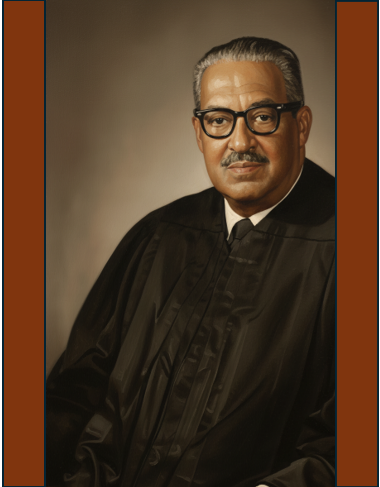
Supreme Justice Thurgood Marshall
The Supreme Court recently dealt a blow to section 2 of the voting rights bill, which limits the voting rights of African Americans in many places in the South and will eventually affect us all. I wanted to remember Supreme Justice Thurgood Marshall. Several years ago, a film was made in Western New York on the life and times of Thurgood Marshall. It motivated this columnist to write an article on his contributions to the civil rights of African Americans.
When I traveled to Washington, D.C. with the First Shiloh Baptist Church Travel Club several years ago, we visited Arlington National Cemetery, where Thurgood Marshall was buried across from the grave site of President John F. Kennedy. I remember thinking how large and impressive his tombstone looked, surrounded by colorful flowers. It seemed to say here lies a man of greatness. I am not sure it is still there with all the removal of our history throughout the country.
However, we must remember his legacy and contributions to our civil rights, when he fought hard for justice through the court system. Thurgood Marshall was the first African American to be appointed to the Supreme Court of the United States in 1967, by President Lyndon Johnson. He began his journey up the federal judicial ladder on September 23, 1961, when President John F. Kennedy nominated him as a judge of the Second Court of Appeals.
Thurgood Marshall was born on July 2, 1908, in Baltimore, Maryland. His parents were William and Norma Marshall. His mother was a schoolteacher and his father worked as a waiter in an all-white private club. Thurgood Marshall credited his parents with giving him a strong sense of confidence, African American pride, and personal dignity. Marshall attended public schools in Baltimore and earned his bachelor’s degree, cum laude, from Lincoln University in 1930. At first, he planned to study dentistry, but he changed course because of his father’s influence. He also remembered that as a child in school he used to act up and his teacher would punish him by making him read passages from the U.S. Constitution. He believed that this helped to lay the foundation for his interest in law. He went on the study law at Howard University. After he passed the Maryland Bar Exam, he married Vivien G. Burney and set up his law practice. He became known as the “little man’s lawyer.” His clients were poor and often could not pay his fee.
He later became counsel for the Baltimore branch of the NAACP. In 1938, he became special counsel for the NAACP. He argued the case of Sweatt v. Painter, resulting in the ordering of the University of Texas Law School to admit Blacks. Marshall co-founded the NAACP Legal Defense and Education Fund. Along with a group of lawyers he won 32 of 35 cases that they brought before the U.S. Supreme Court. By this time, Marshall had earned the nickname “Mr. Civil Rights.”
In the 1950’s he was sent to Korea to investigate charges that the Army was discriminating against Blacks. Until 1964, he continued to argue cases that involved voting rights for Blacks, segregation on interstate buses, and the most famous case of all was Brown v. the Board of Education of Topeka, Kansas in 1954 which removed the legal basis for segregation in public schools.
Marshall was greatly influenced by the civil rights lawyer named Charles Houston. Marshall believed that the best way to challenge racists was in a court of law. He was the great “dissenter” often standing alone or with a minority group of lawyers defending the rights or the poor and oppressed. He was gifted with words, reason, and sense of fair play. He was feared by those who were the enemies of justice. Thurgood Marshall lived from 1908 to 1993. He once said: “my commitments have always been to justice for all people, regardless of race, creed, or color.”
With the current administration in Washington, I am not sure if the monument in tribute to Thurgood Marshall is still in Arlington National Cemetery with the controversy surrounding the issue of Diversity. References made to African American history is still being ignored. However, I wanted to remember my trip and the importance of seeing the monument to Thurgood Mashall as one of the most significant parts of our history.
This columnist is dedicated to remembering our history and sharing it with as many people as possible!! I would like to encourage everyone to speak up, to teach our youth, and to remember this great history.