
Redding’s ‘Graphic Graphite’ Confronts Erasure, Desire and Racial Memory
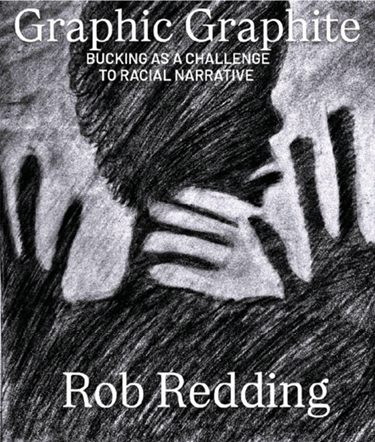
New York, NY — A new drawing concept rooted in negative space and erasure makes its world premiere at Soho Project Space this June as artist, journalist and talk show host Rob Redding debuts work from his forthcoming book Graphic Graphite: Bucking as a Challenge to Racial Narrative.
The exhibition appears during Pride Month on June 9 and ahead of the book’s Juneteenth week release on June 15. The project examines how the United States has buried the rape and sexual violence inflicted on Black men during slavery and expands this inquiry into a broader study of desire, survival and racial memory.
A Culture of Queer, curated by David Biko and Harvey Redding, no relation, introduces this new visual approach as part of a wider conversation about how queer art operates. The work recognizes that queer expression does not need to depict sexuality or identity directly. It only needs to provoke thought and open new ways of seeing.
The technique draws directly from document ed slave narratives and uses absence, removal and viewer interpretation to complete the image. This method extends Redding’s Constructive Expressionism into a form that asks audiences to confront what history has obscured and what contemporary culture still struggles to name.
The premiere image centers on the relation ship between Olaudah Equiano and the young white sailor Richard Baker. The work draws from Vincent Woodard’s The Delectable Negro, a foundational study of erotic consumption and the racial imagination. Redding visualizes Woodard’s argument that Baker fed on Equiano emotionally, socially, and erotically. Equiano appears in full dark complexion with a faint halo that suggests a spirit returning to speak. Baker is rendered in negative space, defined by what he takes rather than what he offers. Their embrace appears gentle, yet the composition reveals a deeper truth. The image shows a love shaped by domination, longing, and the quiet cannibalism that slavery produced.
This image is one part of a larger corpus that includes drawings based on accounts of bucking, forced intimacy, coerced affection, and the psychological strategies enslaved men used to survive. The book includes scenes drawn from testimony recorded in the WPA narratives, Equiano’s autobiogra phy, and lesser-known archival fragments. The project confronts the silence surrounding the rape of Black men and challenges the sanitized narratives that dominate public memory.
This work places Red ding in conversation with Black artists who have shaped the visual language of slavery and racial memory. These include Kara Walker, Glenn Ligon, Hank Wil lis Thomas, Kerry James Marshall, Fred Wilson, Carrie Mae Weems, Lor na Simpson, Whitfield Lovell, Radcliffe Bailey, and Charles Gaines. The project also draws from scholars whose writing has transformed how we understand race, sexuality, and power. These include Vincent Woodard, Saidiya Hart man, Hortense Spillers, Christina Sharpe, Frank Wilderson, Jared Sex ton, Omise’eke Tinsley, Roderick Ferguson, and Darieck Scott.
Together, these artists and scholars form the intellectual and creative architecture of Graphic Graphite: Bucking as a Challenge to Racial Nar rative. The project is not an illustration of history. It is a study of the inner world that history often hides. It asks the viewer to consider how intimacy, desire, and identity are shaped by power and how these dynamics echo into the present.
On the reverse side of the Richard Baker and Olaudah Equiano piece, Redding places a new painting that pushes his exploration of power, desire and representation into a different register. Colonization uses the same monochrome language as his earlier work but turns its attention to how the story of Africa has been claimed and reshaped by whiteness. Only after encountering this inversion does the argument of Origination come fully into view, the earlier painting asserting that all life comes out of Africa and reclaim ing that truth through the Black body. Seen together, the two works expose how the origins of humanity have been repeatedly overwrit ten while Black artists are denied the author ity to narrate their own beginnings. The pairing becomes a single argument about authorship, desire and the right to define where the world begins.
“My work confronts the parts of history that America refuses to name,” said Redding. “The rape of Black men is not a metaphor. It is documented in the record and in the voices of enslaved people. I am creating images that come from their testimo ny, not from the myths we tell ourselves. This project is about desire, survival, and the cost of being seen. It is about what happens when the body becomes a site of memory and a site of era sure at the same time.”