
The Criterion in Time: Two Black Leaders Released By South African Gov’t.
This article was published on December 7th, 1988
The government of South Africa recently released two aging and ailing Black leaders, both colleagues of African National Congress chief Nelson Mandela. They had been prisoners for ten years.
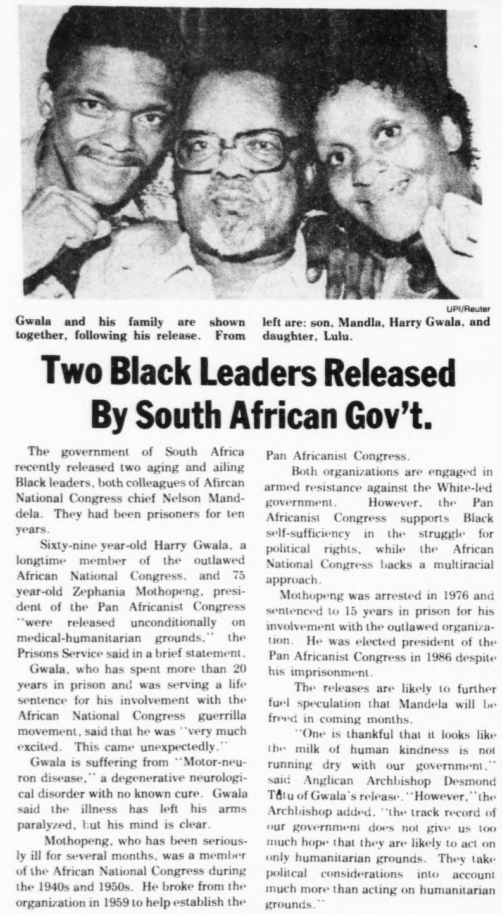
Sixty-nine year-old Harry Gwala, a longtime member of the outlawed African National Congress, and 75 year-old Zephania Mothopeng, president of the Pan Africanist Congress "were released unconditionally on medical-humanitarian grounds," the Prisons Service said in a brief statement.
Gwala, who has spent more than 20 years in prison and was serving a life sentence for his involvement with the African National Congress guerrilla movement, said that he was "very much excited. This came unexpectedly."
Gwala is suffering from "Motor-neuron disease," a degenerative neurological disorder with no known cure. Gwala said the illness has left his arms paralyzed, but his mind is clear.
Mothopeng, who has been seriously ill for several months, was a member of the African National Congress during the 1940s and 1950s. He broke from the organization in 1959 to help establish the Pan Africanist Congress.
Both organizations are engaged in armed resistance against the White-led government. However, the Pan Africanist Congress supports Black self-sufficiency in the struggle for political rights, while the African National Congress backs a multiracial approach.
Mothopeng was arrested in 1976 and sentenced to 15 years in prison for his involvement with the outlawed organization. He was elected president of the Pan Africanist Congress in 1986 despite his imprisonment.
The releases are likely to further fuel speculation that Mandela will be freed in coming months.
"One is thankful that it looks like the milk of human kindness is not running dry with our government," said Anglican Archbishop Desmond Tutu of Gwala’s release. "However, "the Archbishop added, "the track record of our government does not give us much hope I that they are likely to act on only humanitarian grounds. They take political considerations into account much more than acting on humanitarian grounds."