
Clinic operates monthly at Friends of the Night People in Allentown
by Ellen Goldbaum
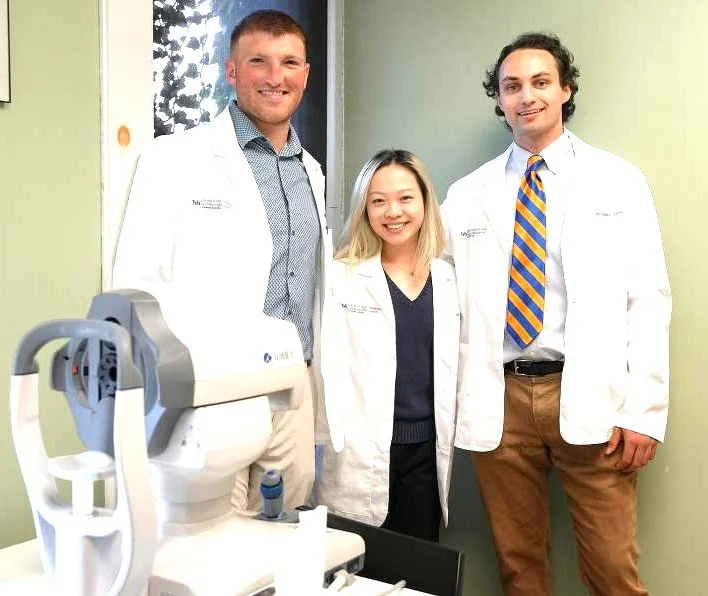
L to R: Sean Beck, Kristen Chao and MP Geiss, all MD candidates in the Jacobs School, welcomed patients to the Lighthouse Free Medical Clinic eye clinic when it opened on Oct. 10. Photo: Sandra Kicman
The woman was migrating to Buffalo when her glasses broke. She was in a new country and had just started a job that didn’t offer vision insurance, so she could neither take off work for an appointment nor afford the several hundred dollars new glasses would cost. For months she managed, but it was frustrating not being able to see clearly.
A few weeks ago, her luck finally changed. She was the first patient seen at the Lighthouse Free Medical Clinic’s new eye clinic, located at the Friends of the Night People, 394 Hudson St. in Buffalo’s Allentown neighborhood. The woman was thrilled, knowing that she was finally going to be able to see clearly again, and it didn’t cost her a penny.
She was one of ten patients seen on Oct. 10, when the free eye clinic – started by students at the Jacobs School of Medicine and Biomedical Sciences at the University at Buffalo – opened to the public. For Sean Beck, the Jacobs School student who is the main driver behind it, the clinic’s opening was nothing less than a dream come true.
‘Nothing compares to that’
Beck first became interested in ophthalmology when he went on a medical mission trip to Nicaragua when he was in high school. He saw firsthand how dramatically a pair of prescription lenses can change the life of someone who needs glasses but doesn’t have them. “Nothing compares to that,” he says, “when you see someone get their vision back.”
As an MD candidate and a volunteer at the school’s student-run Lighthouse Free Medical Clinic, Beck saw how badly free vision care was needed in Buffalo. Less than 40% of Americans have any kind of vision insurance. Even with insurance, the wait to get an appointment with an eye doctor can take months.
But establishing a free eye clinic is no small feat. To identify conditions such as diabetic retinopathy, macular degeneration and glaucoma, providers rely on specialized equipment including slit lamps, diagnostic lenses and devices that measure eye pressure or capture images of the retina. Beck knew that a fully-equipped ophthalmic examination station can cost tens of thousands of dollars, an expense well beyond the budget of Lighthouse, an entirely volunteer-run clinic supported through charitable donations.
He started researching other free eye clinics, drawing on his background as the Lighthouse research and grants coordinator, with assistance from Jessica S. Kruger, PhD, clinical associate professor of community health and health behavior in the School of Public Health and Health Professions at UB and a Lighthouse volunteer.
Kruger had heard that there might be some ophthalmic equipment available at the Friends of the Night People, a local charitable organization. Prior to COVID-19, the organization operated a free eye clinic but the physician who ran it had retired. The equipment was still there but it wasn’t being used. So, Beck met with Joe Heary, the organization’s executive director, who was pleased to help.
Overcoming a major barrier
“That was really a blessing,” says Beck. “The big barrier was getting a slit lamp. The clinic couldn’t have started without that.”
With all the necessary equipment available, including the large mask-like machine called a phoropter, with which patients select the clearest lens, the clinic was becoming a reality. The Lighthouse and the Jacobs School each provided resources and support.
Beck spoke to Chelsea May, OD, chief of optometry at UBMD Ophthalmology/Ross Eye Institute about volunteering at the clinic and she agreed. An optician also agreed to volunteer and Beck recruited three of his classmates.
He then posted flyers at the Salvation Army Food Pantry and at the Lighthouse clinic, providing a QR code so people could sign up. The first day of the clinic went more smoothly than Beck had hoped. They saw 10 patients, from teens to older adults, most of whom have received glasses by now.
And word is spreading: there are now 70 patients on the waiting list. The clinic operates one Saturday each month, and the frequency will likely increase in the near future. Patients wishing to schedule an appointment can leave a message at 716 217-0150; the clinic will call back regarding an appointment.
Thinking back on all the people who worked to make it happen, Beck says it was necessary to have an “it takes a village” approach. He also views it as an important – if unexpected – part of his medical education. His poster about the clinic won a community engagement award at UB’s Bridging the Gaps: Advancing Health Equity in Western New York conference earlier this month.
He presented about the clinic at the national meeting of the Society of Student-Run Free Clinics last month, where he was also elected president of the organization. He plans to write a paper about it to submit to a peer reviewed journal.
“When Sean mentioned he wanted to start a free eye clinic through Lighthouse, I knew it was a big undertaking,” says Sandra F. Sieminski, MD, president and CEO of UBMD Ophthalmology/ Ross Eye Institute and chair of the Department of Ophthalmology in the Jacobs School. “He has impressed me with how resourceful he and the rest of the team were in getting the equipment and support they needed to make this happen. The Buffalo community is truly lucky to have this service.”