
Unified Command Advances Environmental Remediation And Vessel Stabilization At Buffalo Naval Park
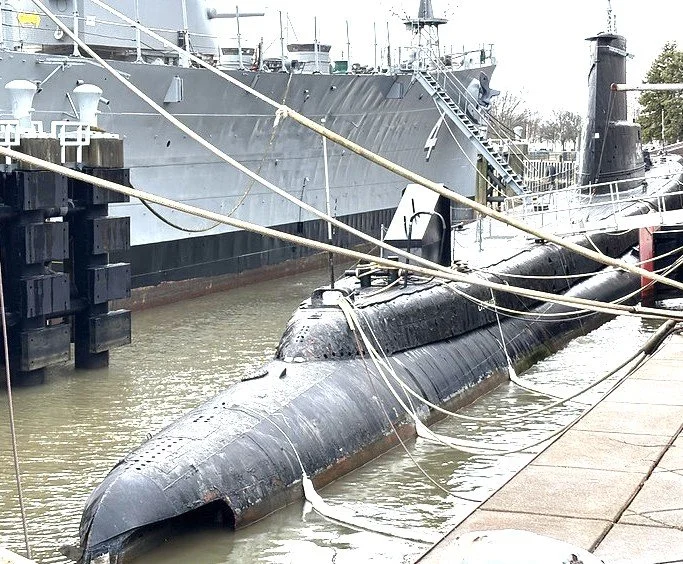
A coordinated multi-agency response by the New York State Department of Environ mental Conservation (DEC), United States Coast Guard (USCG), the City of Buffalo, and Buffalo Naval Park is now underway at the Buffalo and Erie County Naval and Military Park to protect the Buffalo River and stabilize two historically and culturally significant vessels – the USS Croaker and USS The Sullivans.
Today’s launch of operations actions represents a critical early phase of the broader preservation program for the Naval Park’s historic fleet. A pinhole in one of the fuel tanks aboard the USS Croaker and water incursion on the USS The Sullivans have created two potentially hazardous threats to the environment. There remain no reported impacts to wildlife from the intermittent petroleum releases.
“DEC is committed to protecting the Buffalo River and coordinating closely with the Coast Guard, City of Buffalo, and the Naval Park to ensure an effective and safe response at the USS Croaker and USS Sullivans,” DEC Commissioner Amanda Lefton said. “DEC is proud to provide funding and expertise with our partners to clean up and stabilize these historically significant vessels so that future generations can continue to learn about their legacy in protecting our country.”
“The Coast Guard is actively working with the New York State Department of Environmental Conservation, the City of Buffalo, and the Buffalo Naval Park to remove product from the USS Croaker and the USS The Sullivans,” Commander Adam Mosley, the Coast Guard’s Incident Commander, said. “These efforts will ensure the safety of the public, the responders, mitigate environmental concerns and ensure the preservation of a national historic landmark.”
“Our priority is preventing further pollution of the Buffalo River,” Mayor Sean Ryan said. “We are committed to working with our state and federal partners to stabilize the vessels and to address the environ mental concerns identified by the U.S. Coast Guard.”
“Strong public private partnership is what makes preservation at this scale possible,” President and CEO of the Buffalo Naval Park Brian Luallen said. “Local, state, and federal partners have come together quickly to support a practical, cost-effective solution that reduces environmental risk, stabilizes these nationally significant vessels, and keeps the long-term restoration schedule on track. This work is complex and involves the management of substantial volumes of legacy petroleum materials, but it represents meaningful progress toward preparing both ships for dry dock, ensuring their stories can continue to be shared with future generations.”
DEC is the lead State agency under a Unified Command structure that includes the Coast Guard, City of Buffalo, and the Buffalo Naval Park. The response focuses on the safe removal and treatment of legacy residual fuel products typical of historic naval vessels, along with stabilization measures required to manage contaminated water accumulation and support vessel integrity.
Operational planning and resource mobilization began last week, including staging treatment infrastructure and frac tank systems to support controlled pumping, storage, and processing of the oil-water mixture from both ships. The effort is expected to involve the management and treatment of residual fuel materials that have remained aboard the vessels for decades.
The USS Croaker holds an estimated 25,000 gallons of diesel fuel and potentially 115,000 gallons of oily water onboard. The remediation plan involves pumping the oil and water from multiple onboard fuel tanks. Once off-loaded, the stern of the USS Croaker is projected to rise approximately 4 feet, which will place the level of perforations in the hull above the waterline and allow the vessel’s transport. A similar project involving the USS Silversides, a Gato Class submarine and museum in Michigan, was completed successfully several months ago. The project manager from that endeavor was on-site in Buffalo today to offer technical assistance.
The USS The Sullivans holds potentially 30,000 gallons of oily water on board. A consulting naval architect will direct the progress of the work to off-load the oily water in order to ensure the balance and structural integrity of the USS The Sullivans is maintained. Approximately 15 tons of water jeopardizing the structural integrity of the vessel’s hold is anticipated to be off-loaded daily. A separate crew will work to plug leaks in the hull of the USS The Sullivans once an area is cleared. DEC is collecting the oil from the vessel and will recycle it. The recovered water will be off-loaded into portable storage (frac) tanks for appropriate treatment.
Both vessels will be trans ported along Lake Erie to Donjon Shipbuilders in Erie, Pennsylvania, where dry dock repairs will take place to ensure to help save the two vessels and their historic legacy.
The cleanup is being funded through commitments already included within the estab lished public funding frame work supporting the ships’ preservation. Using DEC con tractors provides operational flexibility and allows the work to proceed on an accelerated timeline while maintaining local coordination.
Unified Command partners will continue coordinated operational planning, moni toring, and public commu nication as remediation and stabilization activities advance. The Naval Park remains open to visitors, and safety measures are in place to sup port response operations and ongoing public access where feasible.