
Deed theft victims fight a second punishment after scammers take their homes
by Karen Juanita Carrillo, Amsterdam News
Karen Juanita Carrillo
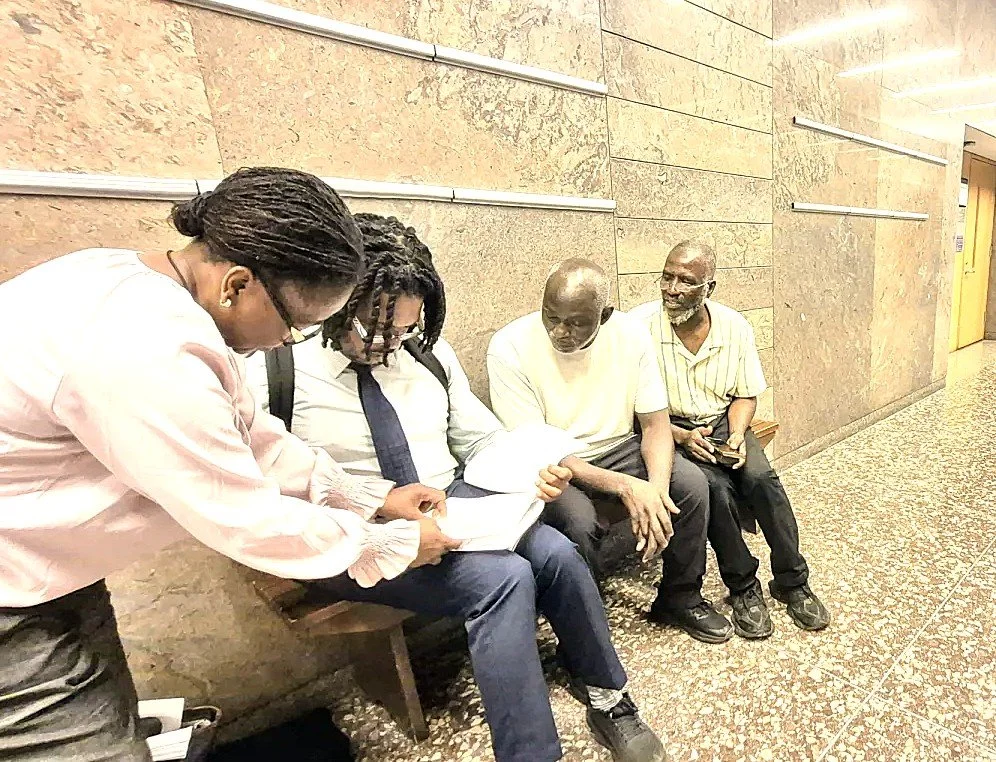
Clotilde “Wendy” Sawadogo and attorney Michael B. Bailey II look over paperwork in the hallways of Brooklyn Supreme Court as Patrice Sawadogo and Gaoussou Ouedraogo look on
Brooklyn homeowners who felt relieved when courts confirmed their deeds had been stolen are now finding out that vindication is only half the battle: even after fraud is exposed, they still have to spend time and money reclaiming property that’s rightfully theirs. Many deed theft victims find that they still have to file motions and affidavits, pay legal bills, and spend days sit ting in courthouse hall ways trying to prove that the home they bought, fixed, rented, inherited, or raised children in was actually theirs.
Gaoussou Ouedraogo and Patrice and Clotilde “Wendy” Sawadogo are still fighting to recover 406 East 21st Street in Flatbush, one of the Brooklyn properties tied to disbarred attorney Sanford Solny’s decade long deed theft scheme. The Brooklyn District Attorney’s office said Solny targeted home owners in foreclosure and falsely promised to help arrange short sales, but instead transferred deeds to himself or companies he controlled. In June 2025, Solny was convicted of stealing deeds to 11 Brooklyn properties; in November, Brooklyn Supreme Court Justice Danny Chun sentenced him to two and a half to seven years in prison and nullified the fraudulent deeds.
But Ouedraogo and the Sawadogos are still fighting to regain their ownership of the Flatbush property, which was sold even though it should not have been. They have been forced back to court to challenge the sale and defend against attempts to remove them from the property. Their other property, 729 Eldert Lane in East New York, was also part of the Solny case. Solny’s conviction helped prove that his victims had been defrauded, but the court did not order him to return nearly $500,000 in rent prosecutors said he collected from stolen properties. Even now, his attorney is appealing his conviction.
Olondi LeGrand says he is also fighting a deed theft case, this one involving property at 964 St. Johns Place in Crown Heights. The Amsterdam News is still reviewing documents in his case Brooklyn, says she had an emergency order to show cause with a temporary restraining order allow ing her to return to her property last month, but local police would not allow her to reclaim her home. Instead, the police accepted the claims of the other people who claimed they owned the property. “And I left because I didn’t want to be arrested because [of] what they’re doing to us,” she told the Amsterdam News. “They turn it on us like we’re … what do and has not independently confirmed all of his claims. But LeGrand insists the public record shows transactions that should have raised questions. “They put a mortgage on the prop erty and had a transfer on the whole property,” LeGrand said. “They allegedly had a purchase of 50 percent interest in the property.”
LeGrand argues that many deed theft victims are pushed into representing themselves after years of paying lawyers. “The judicial system is showing this systematic and problematic conduct which is happening to pro se litigants who can no longer afford lawyers,” he said. LeGrand claims that even when victims can afford to pay for an attorney, they later feel they weren’t fully represented by them.
LeGrand says he is put ting together an event called T.R.A.C.E.R.S. (Transparency, Resources, Accountability, Enforcement, Resolutions, Strategic Solutions) as a community round table for homeowners, advocates and officials to discuss deed theft, elder exploitation and ways to protect family property. The next roundtable is scheduled for Thursday, Aug. 13, from 4 p.m. to 8:30 p.m. Organizers say invitations have gone to Peter S. White of the mayoral office of deed theft prevention and Edwin Raymond of the NYC Sheriff’s Department, though their attendances had not been confirmed by AmNews deadline.
Vira Jones, who has been fighting to get back into her four-family home at 130 Greene Avenue in Clinton Hill, Brooklyn, says she had an emergency order to show cause with a temporary restraining order allowing her to return to her property last month, but local police would not allow her to reclaim her home. Instead, the police accepted the claims of the other people who claimed they owned the property. “And I left because I didn’t want to be arrested because [of] what they’re doing to us,” she told the Amsterdam News. “They turn it on us like we’re … what do they call this — and throw us out.”
Jones said she tried to show the court order to the police. “I said, ‘This is a judge’s court order: She signed it! Look at it!’” she recalled. But in the end, she backed down. Now, she says, she is preparing to return to court on Aug. 13. Like the other home owners, Jones is fighting over the meaning of homeownership in a city where stolen deeds can still leave victims paying the price. For information about T.R.A.C.E.R.S., contact Stopdeedtheft.us@gmail.com.