
New York State Museum Marks 25th Anniversary of Sept. 11th Attacks with New Photography Exhibition, Rarely Seen Artifacts on Display, and Public Programs
New photography exhibition Witness to 9/11 documents the attacks and their aftermath through the work of two New York Daily News photojournalists
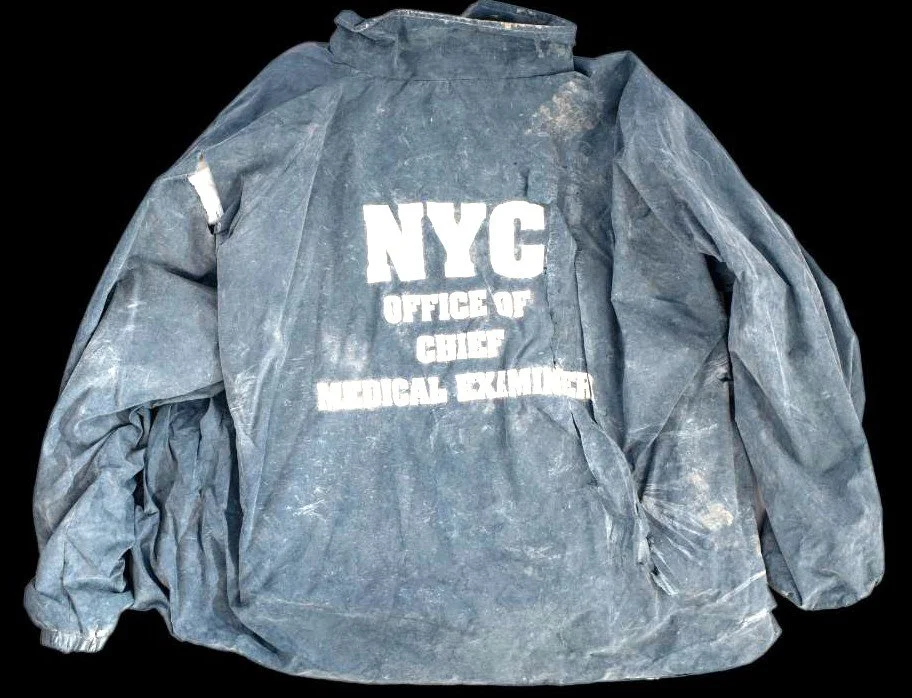
A windbreaker worn by forensic specialist Brian Gestring is among new artifacts that will be on display at the New York State Museum.
The New York State Museum today announced a new photography exhibition, a new display of rarely seen artifacts, and a series of public programs to mark the 25th anniversary of the September 11, 2001, terrorist attacks on the World Trade Center. Together, these exhibitions and programs honor the lives lost, those who responded, and the lasting impact on New York and the nation.
Opening September 5, 2026, Witness to 9/11 is a new photography exhibition that explores the immediate response and aftermath of the attacks, told primarily through the work of two New York Daily News photographers, Todd Maisel and David Handschuh. Both were among the journalists who responded to Lower Manhattan that morning, unaware of what would unfold. In addition to documenting the attacks, Maisel assisted when Handschuh was seriously injured in the collapse of the South Tower. Together, their photographs capture both the devastation of the attacks and the extraordinary human response that followed.
Photographs taken by Maisel and Handschuh at Ground Zero are displayed alongside artifacts, including Maisel’s Nikon camera, a damaged cast-iron lamppost that had formed the western boundary of the World Trade Center complex, and a fragment of fuselage from a Boeing 767 that was recovered by staff at the Intrepid Air and Space Museum. The exhibition will be on view through May 2, 2027.
Witness to 9/11 serves as a complement to the Museum’s long-term installation, World Trade Center: Rescue, Recovery, Response. The existing gallery, which opened on September 5, 2002, will be updated to include a windbreaker worn by forensic specialist Brian Gestring when he responded to the site. Gestring, a member of the New York City Office of the Chief Medical Examiner, was in front of the Marriott Hotel when the South Tower began to collapse and was evacuated by boat to New Jersey. The jacket was recovered separately, having been misplaced following the collapse.
Museum Director Jennifer Saunders said, “Twenty-five years after September 11, the responsibility to preserve and share the history of that day is more important than ever. For millions of New Yorkers, these events remain a deeply personal memory; for a growing generation, they are history understood through the photographs, objects, and stories that have been preserved. The New York State Museum has a unique responsibility to safeguard that record. These photographs and artifacts bear witness not only to unimaginable loss but also to extraordinary courage, service, sacrifice, and resilience. By bringing these stories forward, we honor those who were killed, those who responded, and all those whose lives were forever changed, while ensuring that future generations understand the profound and lasting impact of September 11 on New York and the nation.”
David Handschuh said, “On September 11, 2001, photojournalists ran towards danger alongside hundreds of rescue workers. Twenty-five years later, we are suffering the same life-threatening illness as far too many first responders. We owe a big thank you to the New York State Museum for featuring exhibits over the past two and a half decades that assure not only that no one will ever forget, but that we will always remember the sacrifices of so many.”
Todd Maisel said, “I could never have imagined that I would be rescuing the rescuers. And that is what I found myself doing on September 11. At the same time, I realized that many of my firefighter and police officer friends that I’d known had perished. I questioned myself as to why I am alive and the heroes were gone. It occurred to me that my surviving unscathed twice was no accident and that there was a deeper purpose. I had something more important to do and that was to tell the story - maybe this was part of the newest testament. Nonetheless, I would swear to never forget.”
Brian Gestring said, “When forensic scientists look at evidence, we try to recon struct events from a quick snapshot in time. I could never have imagined that something I wore on a day-to day basis would face similar scrutiny and end up in a museum frozen in time. On September 11th, I was caught under the collapsing South Tower and nearly killed. My last memory was trying to dive under an FDNY ladder truck for cover. To this day, I have no idea how I got from trying to dive under a firetruck on Liberty Street to where I was found, or how I made it out alive at all. While I had a long and often difficult road to recovery, I was still more fortunate than many of the other first responders who were just feet from me when the South Tower collapsed.”
In addition to the exhibi tions, the Office of Cultural Education has scheduled a series of public programs throughout September.