
NYS Announces Recognition Of The Office Of Mental Health’s Chief Advocacy Officer
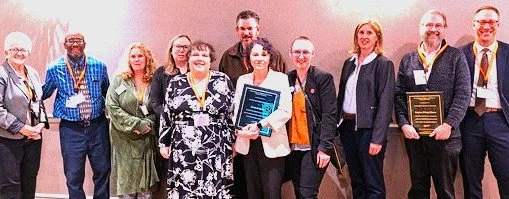
Chief Advocacy Officer Liz Breier, center, celebrates with OMH colleagues after being honored by the Alliance for Rights and Recovery,
The New York State Office of Mental Health today announced that Chief Advocacy Officer Liz Breier has received an award from the Alliance for Rights and Recovery for her efforts to empower peers and advance their work statewide. Breier was recently presented with the ‘Brendan Nugent Empowerment Award’ at a ceremony during the state and national advocacy organization’s annual conference in Albany, reflecting her work to continue integrating peer support and individuals with lived experience into shaping the public mental health system.
“Peer support helps to build trusted relationships with individuals connected to the mental health system, improving outcomes by promoting hope, choice, self-determination, and mutuality,” OMH Commis sioner Dr. Ann Sullivan said. “This award recognizes Liz’s tireless advocacy and her dedication to ensuring people with lived experience have a major voice in our system of care.”
In recognizing Breier, the Alliance cited her strong belief that peers are essential partners in designing, delivering, and improving behavioral health services. The organization also cited her tireless advocacy to expand opportunities for the peer workforce, create pathways for them to develop professionally, and for them to take leadership roles and influence the future of behavioral health services statewide.
“Liz Breier is one of those rare leaders who has the skill and strength to translate the principles of recovery, human rights, and peer support into pragmatic public policy advances,” Alliance for Rights and Recovery CEO Harvey Rosenthal said. “She has worked tirelessly to promote a broad array of peer-led innovations, including outreach and engagement, crisis diversion, hospital to-community transitional support, and advocacy and support services. We are pleased to honor her with this award, recognizing her dignified work and her continued partnership with the Alliance.”
As OMH’s chief advocacy officer, Breier oversees the Office of Advocacy and Peer Support Services, is a certified psychiatric rehabilitation practitioner, and has been dedicated to empowering individuals in creating and sustaining their personal visions of healing and wellness.
Breier has played a pivotal role in shaping a service system in New York that is person-centered, collaborative, wellness-focused, and trauma-responsive. Drawing from her personal lived experience, she brings valuable expertise to her work, supporting others in their journeys toward self determination and healing from trauma. “I’m very honored and grateful to receive the Brendan Nugent Empowerment Award,” Breier said. “I’m humbled and I don’t take this lightly.”
The award is named for the late longtime advocate Brendan Nugent, an early rights and recovery movement leader. During the 1990s, he organized the first public march and demonstration led by members of the recovery community calling on policymakers to prioritize the voice of the people, in keeping with the Alliance’s core principles of “Nothing About Us Without Us.”
The Alliance also posthumously honored Regina Shoen with the Frances Olivero Advocacy Award for inspiring community leadership and advocacy on behalf of New Yorkers with psychiatric disabilities. Shoen, who died in March, was a dedicated peer advocate at OMH and later became the director of the Upstate Bureau of Regional Advocacy and Peer Support Services for Adults and Youth in the Office of Advocacy and Peer Support Services.
Shoen’s efforts helped implement the New York Peer Advancement Network and Peer Expansion Grant and the Benefits Workforce Incentive Navigators, which have created systemic impacts throughout the state’s mental health care system. In recognizing her, the Alliance noted that she “spent her life working to dismantle the stigmas that keep so many suffering in silence.”
Peer specialists are playing an increasingly important role at OMH-operated facilities, with agency licensed providers, and with funded programs. The state now supports a professional certification pathway, including certified peer specialists, family peer advocates, and youth peer advocates, with these workers being a key component of OMH’s workforce development efforts for Medicaid billable and non-billable services and support.
In addition to supporting peer workers at state operated psychiatric centers, OMH is funding Peer Bridgers and providing technical assistance for this initiative at three Article 28 facilities. Peer Bridgers engage patients before they are discharged and maintain trusting relationships with them afterward, providing ongoing support within the community for up to a year following their discharge.
OMH is also funding Intensive and Sustained Engagement Team programs, a peer-led engagement approach to support people who haven’t had success in the traditional mental health system and may be at risk of involuntary treatment. These teams are providing support for at least 60 individuals monthly who might not have otherwise engaged in treatment.
Also in the community, OMH now funds eight Clubhouses, peer-driven programs fostering improved community integration for volunteer members that help to reduce social isolation and promote recovery. These are non-hierarchical environments where members and staff — who often have lived experience — work side by side, helping to avoid hospitalizations and readmissions.
OMH’s successful ‘Safe Option Supports’ program relies heavily on peer special ists to conduct outreach and successfully house individ uals experiencing chronic homelessness. Peer workers also serve in crucial roles in their direct communities, operating recovery centers, warmlines, drop-ins, and other peer-led and peer-run programming.