
Do Most People Oppose New AI Data Centers? Examining Who Opposes and Supports Them
by Christin Bratton

Christin Bratton
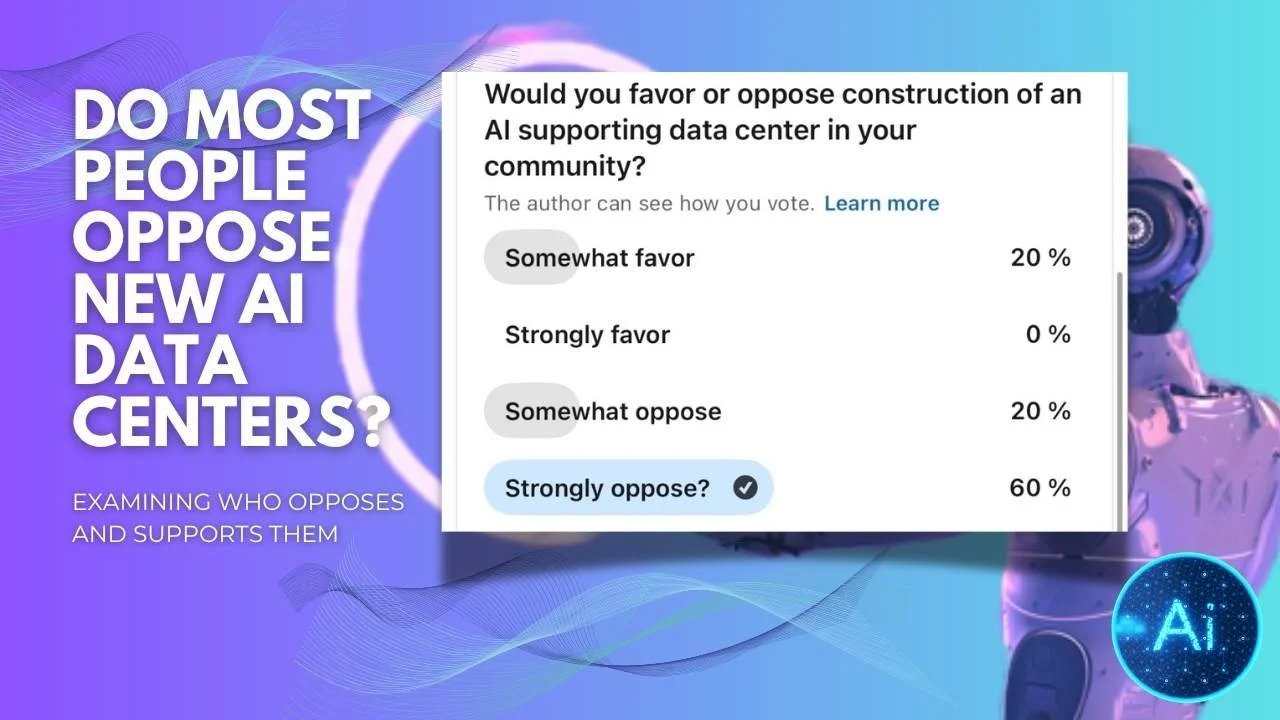
For the past two weeks, I have held an open poll to see whether people in the community and across different states oppose or favor the construction of artificial intelligence data centers. Sixty percent of individuals strongly opposed the construction of new AI data centers, 20% somewhat favored them, and 20% somewhat opposed them. In my last column contribution, I focused on exploring some reasons why AI data centers may be excluded from environmental review. I shared several cases that demonstrated how leverage, money, and political influence allow some companies to bypass the environmental review process, resulting in passive responses to community members who clearly reject the construction of new data centers in their areas. With so much opposition, why are some people still in favor of these developments, and what is driving that support?
First, let’s understand who exactly is opposing these projects and who is in favor of them.
Based on the survey I conducted, the individuals who strongly opposed the construction of AI data centers held positions in environmental justice, disaster risk management, and environmental preservation. As discussed before, AI data centers pose alarming risks to air quality.
We have already seen declines in respiratory health within minority communities in Tennessee due to excessive air pollution.
There is also the issue of habitat loss when a new building replaces untouched land or existing structures in rural areas, the type of areas filled with lush landscapes and open space for wildlife to exist unbothered.
The individuals who somewhat favored the construction of new AI data centers held positions in community planning for disaster recovery, visual content production, and digital asset development. Many of these professionals look to AI as a tool that produces positive results. Community planners rely on AI to automate routine tasks such as permitting and data analysis, forecast demographic and infrastructure needs, and summarize large volumes of public feedback. These tools are transforming local government operations and making planning, building, and code enforcement more efficient.
It is clear that individuals often oppose or support AI depending on the personal or professional benefits they receive from using the technology.
AI is a helpful and effective tool that is quickly shaping workflows and advancing companies. A content creator might use the tool to generate more attractive ideas. Contractors and consultants use AI to outsource services more easily and reduce costs. Fifty percent of tech workers use AI to assist with software development. Emergency management agencies are slowly trying to incorporate AI into disaster recovery and grant processes. CEOs value AI because it reduces labor costs while increasing profits, even as employment numbers continue rising despite concerns about whether those “open jobs” are truly resulting in hires. Finance specialists use AI to reduce human error, automate repetitive tasks, and analyze massive datasets at extremely fast speeds.
With AI already widely accessible, many people question why they should continue performing difficult or repetitive tasks manually when faster automated systems are available.
The problem is not that AI is inherently bad or that all AI data centers should be rejected entirely. The problem is the dismissal of the environmental and social impacts placed on communities that will be negatively affected by these developments. If CEOs, public officials, local governments, state governments, and stakeholders are secretly closing deals on new AI centers while reducing transparency, that sends a message that communities are viewed as inferior and disposable.
Over time, this pattern can contribute to declining quality of life, worsening health conditions, reduced environmental protections, and increased disregard for human well-being.
What is the solution? We must establish a highly regulated and transparent development and review process for all AI data centers. There must also be stronger representation for minority communities in government decision-making, a rejection of bias over reality, and a rejection of favoritism toward individuals with power or wealth.
Everyone can benefit from AI when it is used responsibly. Employees, doctors searching for cures to diseases, students preparing for exams, artists developing new ideas, and businesses trying to improve efficiency all benefit from the technology when it is used for its intended purpose.
The problem begins when the environment, social rights, public health, and the quality of human life are threatened by greed, exploitation of communities, resource extraction, and unchecked development.
Everyone may have access to AI, but when one group receives most of the benefits while another receives most of the environmental and social damage, it creates disproportionate inequality.
As an environmental scientist, I frequently examine how land may be disturbed by actions such as resource extraction, land acquisition, habitat loss, ecosystem disruption, and declining air and water quality, along with the long-term impacts these actions have on human quality of life. So far, what I am noticing is that not only is the land being disrupted, but more people are speaking up about their health being compromised. At the same time, the employment market surrounding AI is being presented as a new revolution of growth and opportunity, when in reality, the statistics are often unclear, misleading, or not properly broken down.