
The Enduring Tragedy of “McJosh” Allen
by Gregory Brown
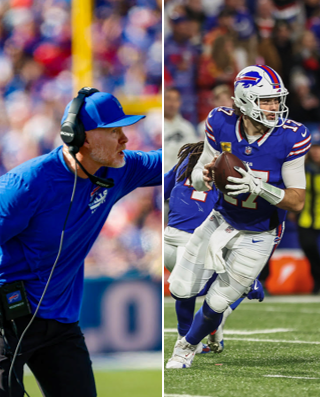
Photos by Jerome Davis
Bills Nation has been down this road before. However, it still doesn’t ease the pain of another heartbreaking playoff exit, this time to the 1-seeded Denver Broncos 33 – 30. I was already on record as saying that the Bills wouldn’t get far in the playoffs. So, just making it to the divisional round and narrowly losing in an overtime thriller should have at least made me somewhat happy. Wrong!
This loss hurts just as bad as it did the last seven times around. And even when we’ve solemnly sworn not to allow ourselves to become so caught up - to remain aloof and emotionally detached - so many, like me, still wind up drinking the Kool Aid. And immediately thereafter, we become true believers; thinking that this time around it will be different.
But, in the grand scheme of things, this game played out just like all the others. Another playoff loss in a never ending sequel that probably won’t ever change until our unhappy burg can somehow manage reverse our enduring Buffalo Curse. This game was Deja-vu all over again.
In some ways, these constant playoff losses are a continuing tragedy with an almost Shakespearian quality to them. Indeed, if the long-departed Bill Shakespeare had been a football fan, he would have undoubtedly told the wretched story of our Buffalo Bills and their heroic, but star-crossed quarterback, Josh Allen.
Shakespeare wrote in the genres of both comedy and tragedy. Comedies had happy endings; tragedies have sad endings. This Shakespeare play, which he would have aptly titled “McJosh,” would have been a nail-biting drama about a broke, downtrodden village and McJosh, its star crossed quarterback. The village, in an age of post industrial decline, pinned all of its hopes for revival on McJosh, who was the greatest quarterback in all the land.
The problem is that as great as he is, McJosh has always waged a never ending internal battle against himself. It has been a struggle between good and evil, but more specifically, between ‘Good McJosh’ versus his evil twin, ‘Bad McJosh.’ Most of the time, Good McJosh prevails but every now and again, Bad McJosh breaks free of his chains only to destroy all that Good McJosh has rendered.
And, so it was that this intense personal struggle took center stage in the Mile High Kingdom of Empower Field. At first, Good McJosh seemed relentless in his determination to lead his poor, rust belt village onward to relevance and prosperity. That is, until he wasn’t.
McJosh’s first fatal error came when he fumbled the village’s sacred rock on a meaningless play, wherein he had but to take a knee and simply allow time to run out on the first half clock. Instead, he fumbled away the precious stone with a mere two seconds left on the clock, which gave the Kingdom a freebie that would lead to a field goal and the ultimate three point margin of victory by which the village lost.
After that fiasco and emboldened by his success, Bad McJosh unleashed even more evil machinations – another fumble and two costly interceptions of the sacred rock. Of course, one of the turnovers was helped by a group of striped animals called zebras lurking in the nearby woods. Ultimately, it was these ogres, whose thumb on the scale, tipped the balance between victory and defeat.
But still, as if to right the cosmic wrong, the football gods had given Good McJosh several last chance opportunities to right the mischief caused by Bad McJosh.
First, were a couple of underthrown passes to his wide receivers, Kahlil Shakir and Mecole Hardman, that would have seized vital territory from the Kingdom and allowed the village to continue its inexorable march forward. But even after those critical errors, McJosh misfired again with an overthrown missile to tight end Dawson Knox that would have scored a touchdown and thus sealed the Kingdom’s doom.
But, in the end, not only did Bad McJosh cause the downtrodden village to mourn what should have been an historic victory, it has also led to the unfortunate overthrow of Sean McDermott, the now deposed King of the village.
Damn you, William Shakespeare.